


Picture casting just above riffles and tumbling a juicy, green morsel down through the holding water, past some pocket water and into the drift. Short casts at first, covering the water before you. Incrementally you work the line out and watch for the darting take, the stop in the line and the set…the moment realized. 7″ or 17″ part of the thrill is know the fish took your creation as it tumbled down through the aerated water.
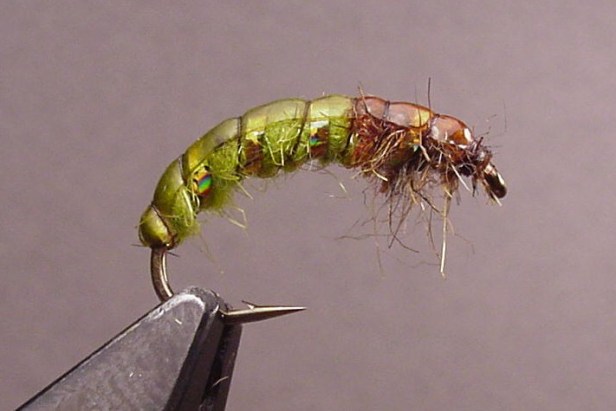
A Green Rockworm pattern is a juicy larva of the caddis genus~~Rhyacophila. It has no case, so it is like lobster or shrimp without the shell. By the time you have celebrated Mom’s Day or planted your string beans and peas, caddis are percolating in your river. You can add bead head pupa patterns and Elk Hair caddis to the mix as the season or hatch progresses. All these patterns can be tied in larger sizes of size 8 to 14, which makes for comfortable tycing, casting, fishing and catching…what more could you ask for. Green to greenish tan, segmented, legs and not to fat a head for the larva will do the job. V Rib, beads, whatever you use add segmentation and a bit of curve. The Czech Nymph lends itself well to caddis larvae.
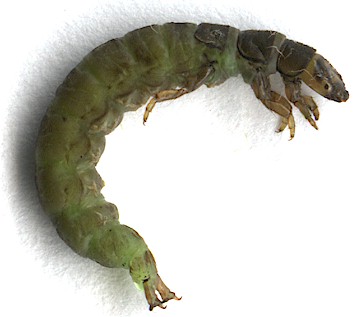
Larva pic from WorleyBuggerFlyCo.
http://www.worleybuggerflyco.com/Yakima_River_Hatches.htm
Czech Nymph Pattern at www.glennriver.com
(See Comment by Guy Stottlemyer; I made his text bold in two places )
 SwittersB & Exploring
The image labeled “Rhyacophila Larva” on the page Green Rockworm Larva (drifting and tumbling through the riffles)does not depict a Rhyacophila larva. The image shows a larva with all three thoracic segments clearly showing a dorsal sclerite, and on Rhyacophila larvae only the first segment or pronotum would have such. It is unclear whether this larva shown has ventral gill filaments or a brush of setae on the anal proleg since these can collapse against the body when out of water. If these structures were present, I would guess this to be a member of the Hydropsychidae (net-spinning caddis) family. If theses structures are truly absent, then possibly a Ecnomidae species but my money is on Hydropsychidae with some structures not displayed.Green rockworms and netspinning caddis are arguably the two best caddis types for fly anglers to imitate. Net-spinners are everywhere and as filter-feeders are often dominant in larger waters even those marginal by trout standards. Rhyacophila are more restricted needing cool, highly oxygenated waters, typical brook trout waters. Green rockworms are generally predators.
LikeLike
Thank you, Guy. I appreciate the clarification
LikeLike
Great site!
LikeLike
Thank you, Eric. Please visit often.
Switters
LikeLike
I like the new banner picture!
LikeLike
Thanks,
the header would only let me insert a portion…some of this stuff is difficult for me to figure out…the picture itself was taken by my son, Tony, last Summer. I think I posted under Adams and it shows fly (an Adams) perched upon his fingertip, back lit by son, at a nearby lake…his artistic side…thanks for comment.
Gary
LikeLike