

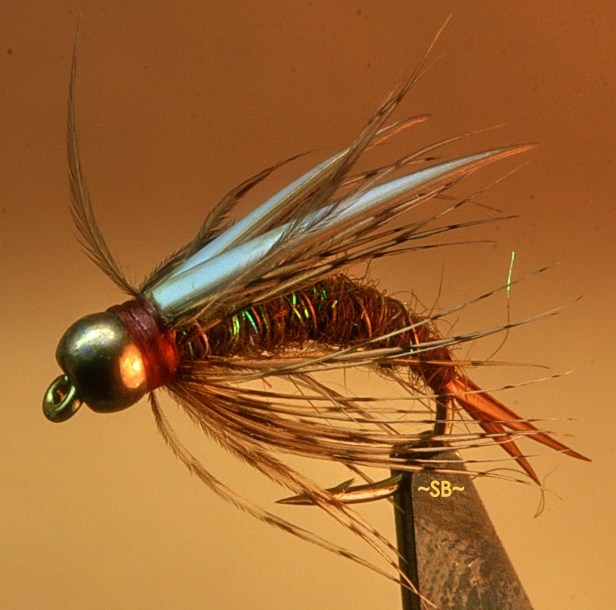
This is a variation of the Prince Nymph or Pupatator (no peacock herl body here). A size 14 hook (size 10-14 optimum) was used. I slid on a brass bead (pick your color). A matched pair of brown goose biots was tied in at tail with the dull side or curved side of the biot outward. This aids in obtaining a separated or flared tail. Next tie in a copper wire ribbing and pull it back out of the way over the tail. I twist dubbed a brown synthetic blend onto 8/0 maroon thread. The dubbing noodle is wound up the shank to build a tight, tapered body (abdomen & thorax). The copper wire ribbing was counter wrapped against the ‘grain’ of the dubbing (this allows the ribbing to not sink into the body material and not disappear). A partridge feather was tied in by the tip and wound twice and tied off/clipped. Two matched, white goose biots were placed atop the thorax area and secured with a semi tight thread wrap. I then manipulate the biots farther apart and then cinch down and continue to build up thread wraps behind the bead head. A whip finisher or hand finish is used to complete the fly.
I have since been told that this pattern is sometimes called a Royal Prince Nymph. Substitute red thread for maroon and a peacock thorax (herl or Ice Dub) to be more exact. The curved shank (my unfortunate habit/obsession) is another variation of the pattern compared to the traditional straight shank Prince Nymph.
 SwittersB & Exploring