

Recently, I was fishing a beautiful stretch of water in Oregon. I had worked my way down to where the riffles converged with perfect seams, edges and rolling riffles. Fish were caught and the afternoon was winding down well. As I stood knee deep next to a twenty yard long riffle, my attention was drawn to mayflies hovering six inches to a foot above the riffles. They were bright yellow, about 1/2″+ long in the body. There were also two long tails, well beyond the length of the body. The mayflies were emerging out of the riffles; just appearing and hovering. There was no surface activity, although I could see some trout slashing beneath the surface next to the riffle. I had some success with a smaller tan emerger pattern. Also, I ran a dark nymph down through the riffle and caught a couple of trout.
 So, I left the river wondering what that mayfly was. I am not adept at identifying all the mayflies beyond a few common, prolific ones. So, I queried Westfly and Troutnut and there seemed to be some likelihood the mayflies I saw (given the size, color, hatching location, actions) might be a ‘Yellow Quill’ or a mayfly from the genus Epeorus. The pictures and descriptors really seemed to match my observations. What stood out was the advice that this insect is best presented by a subsurface pattern, an emerger pattern that depicts an emerging mayfly well below the surface, unfolding and rising….trying to escape the current and ultimately the surface film.
A little query here and there lead to UK Fly Dressing, which had a nice discussion on the ‘yellow may spider’…a wet fly presented for a bright yellow mayfly. Within the forum discussion, the renowned Hans Weilenmann of Danica fame, provided additional information for a yellow wet fly pattern and a wonderful tutorial. Beautiful patterns and visuals for sure.
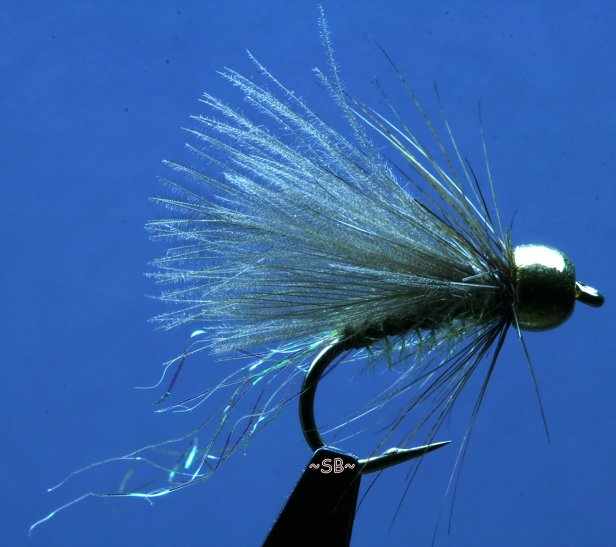
Mindful of the riffle I had observed (depth and velocity) I thought I might concoct a little pattern that would suggest the color, emerging wings and sink to the needed depth. So, I came up with a pattern I am most excited to try. I suspect it will work for other insects as well.
Pattern Information:
Black 8/0 thread; Size 12 TMC 3761 Nymph hook; gold bead, yellow Nature’s Spirit Peacock stick; trailing tail is Fly Tying Specialties Hare & Ice Dubbing (Tan); underwing two CDC feathers; hackle two turns of brown hen hackle.
 SwittersB & Exploring
It is fascinating, isn’t it? A never ending puzzle, with much to learn…many layers. The old adage of no silly questions, holds here. This is a blog, at least, for the beginner. Regardless of how accomplished many FFer’s seem, they all started from scratch re entomology (bugs). I would advise two things: select your favorite/likely to be fished waters and identify the insects you are likely to see. Then study how to present the fly patterns to best imitate the actions of the insect and where it would be in/on those waters. Best wishes
LikeLike
The nymph is generally bigger, providing a casing for the pupa/adult to develop. As the insect escapes the nymphal body or casing the the soon to be adult is, I believe, fully formed as it makes its way to the top. As with some mayflies/midges the process takes place at the surface (just below or in the film)…it is one of the coolest parts of fly fishing….the evolution of the insect from nymph/larva to adult.
LikeLike
Nice pattern for sure! Thanks for the recipe!
LikeLike