

I was going to write the ‘back eddy’ but I think it is better to describe it as the shoreline eddy. The fly fishing literature will usually suggest the eddy is a ‘smorgasbord’ of food for trout (when did you last lay eyes on a smorgasbord?). Most eddy’s are the size of your car or smaller, with the occasional mega one. A shoreline projection into the current or bend in the river will create the eddy. Regardless of their size, food (insects) is funneled into these revolving, carousel like pools. The eddy, at some point, because it is rotating, doubles back up river against the normal downstream flow. The trapped food items are vulnerable to a trout, and your approach, if not stealthy, makes you vulnerable to a fish’s view. So, plenty of fish food and fish is exciting. But, the challenge will be the presentation. A dry, an emerger, a streamer drawn through hoping for that hit?
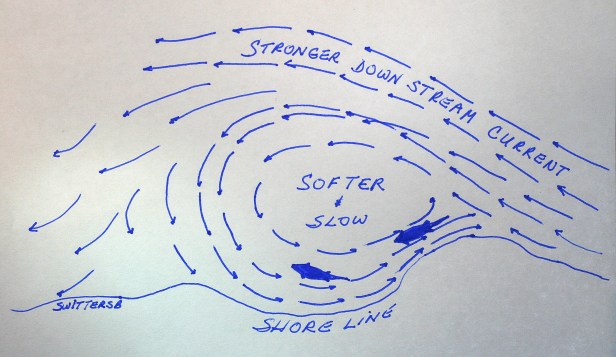
This is one of those times you really should slow down with your approach (it is always said you should slow down, but often we fail to stop and study the water from the edge out). Once you spot the eddy, stop. Get a clear view. Can you back off and observe for a while? The fish will be sipping or right below the surface taking in the trapped insects. Think how you are going to present a fly into that slowly revolving window without spooking the fish. A long leader is ideal for a probably small offering. If possible and safe, can you climb above the eddy and safely, stealthily look down to study the activity?
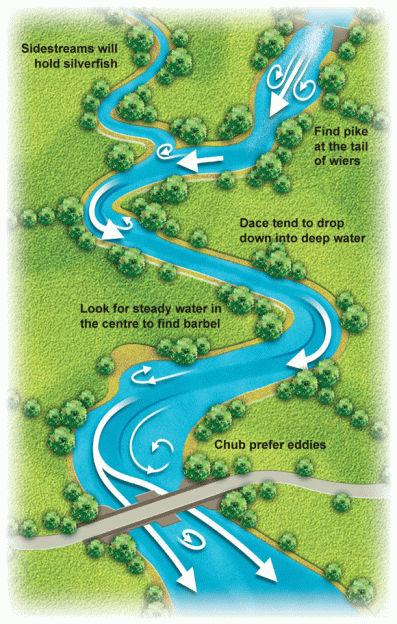
How will you present the fly while staying low, watching your fly, dealing with possible wind, and avoiding too much drag? You will not get too many chances here so take your time to watch how the fish are/is feeding. Then consider your cast, where the fly will travel given the current and where the fish is in relation to that path. Don’t just chuck and chance it.
Do a little research on Pale Morning Duns, a Summer time pattern that likes the quieter back waters, particularly a shoreline eddy.
 SwittersB & Exploring