

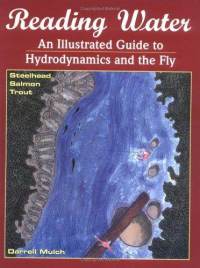
Today, I was perusing a book by Darrell Mulch called Reading Water, An Illustrated Guide to Hydrodynamics and the Fly (2001). The book has a lot to contemplate while presenting materials about the holding patterns of fish in various hydraulic scenarios.
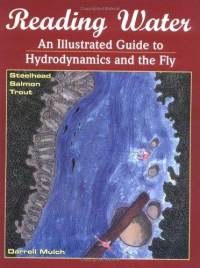 On the very last page, a section entitled The Beginning, there’s a passage that I thought interesting: “However, in a store, flies are usually tied to either attract fish or fishermen. That is, they are made to look like a specific insect or they are made to appeal to the fishermen’s understanding of beauty. Ugly flies, though, are constructed to interact and relate to the characeristics of moving water to produce an animate behavior. The image they present to the fish is dynamic; it is seen as a cinema (a sequence of events), instead of a snapshot (a moment frozen in time).”
The ‘Ugly Fly’ patterns in the book are scraggily, wavy patterns that move upon and under the water’s ‘roof’ as Mulch calls them. I like the Cinema (fluid movements) vs. the Snapshot (static) idea. I have long suggested the impressionistic pattern is preferable to the perfect replica pattern on many occasions. Rather than being my excuse for sloppy tying, perhaps Mulch has given me even another reason to tie my unkempt patterns.
 SwittersB & Exploring
I too come from the school of impressionistic fly tying. While I admire the skills of those who practice the craft of the trompe l’oeil style of tying, it has always seemed so unnecessary to me. Buggy is good. Ugly is good. And water is an important ingredient in almost every fly I ite. Dave Hughes wrote that “trout aren’t interested in neatness.” That has always been my experience, too.
Perhaps Bill McMillan said it best when he stated that, “Intricate fly patterns are for the human mind, not the fish’s. I don’t like to pretend that a fish is more complicated than the rather primitive animal it is.”
LikeLike
The concept of impressionistic flies, those with “the illusion of life” has been central to the mindsets of many well known anglers, Polly Rosborough (Fuzzy Flies) and Sylvester Nemes (The Soft Hackle Fly Addict) to mention two. The way I figure it is that much of the time you don’t know what the fish are actually eating, were it possible to make an “Exact immitation” the problem would be that you are at least as likely to be “wrong” as “right”, With more impressionistic and mobile flies the same pattern can cover, emergers, drowned Duns, nymphs, pupae, and more. It is a foolish angler who ignores these flies, and certainly where I fish, presentation is more important than pattern most of the time. But you aren’t let off the hook, impressionistic flies don’t have to be “sloppy”, I like to tie my subsurface patterns in a state of what I call “disarray by design”, much of that achieved with loose dubbing and vigorous application of a dubbing brush or piece of Velcro. Thanks for the post.
LikeLike