

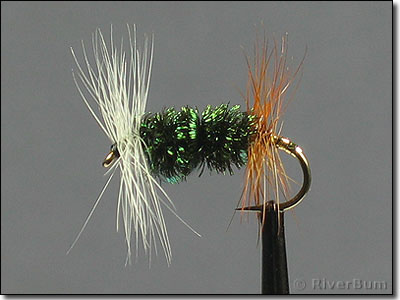
The Renegade was first intro’d to me by Harry Teel about 20 years ago on the Crooked R. one evening. I have remarked about this before, that with all the flies at Harry’s disposal and with his years of knowledge, he was fishing an evening hatch of caddis with the Renegade. I am sure he could have gone straight to the EHC, but he worked the seams of the riffles with the Renegade and, of course, caught fish after fish. A few years later, I was in B.C. fishing a lake full of Kamloop’s east of Little Fort. My memory is that I caught so many trout on the Renegade that long after the white hackle had been decimated and was trailing behind held only by the tie in point, the fly continued to catch fish. I still remember holding it up to my son, Evan, and remarking ‘watch this’ and sure enough the cast produced another torpedoe off the drop.
The fly is a simple tie and the proportions you see above are important to produce the swept back hackle fibers, so don’t use dry fly grade hackle, nor schlappen style either. Create the image in the pic. The gold tag for a touch of flash is always there too. I think you fish this dry for as long as it stays afloat and then if it goes wet, all the better. A fat peacock body is important and I would tie this in sizes 10-14. I have caught more trout on the size 10 than the size 14! Forget a bead head or ribbing. As usual, if it gets that tattered…you have had a great time and you can tie on another one. The late Ed Story’s Crackleback is a close second to the Renegade.
 SwittersB & Exploring
i would like the pattern for the Renegade fly
LikeLike
http://midcurrent.com/videos/tying-a-renegade/
pay attention to the hook’s wire (light wire/heavy wire). The fly usually should float and if it goes under a bit fine. However, I have fished it in lakes, deep with tremendous success. The hackles should, when wound, be one and a half times the width of the gap. The hackles should not be stiff, dry fly hackle. You can add the gold tinsel tag at the bend or omit. I like a plump body too. Good luck
LikeLike