

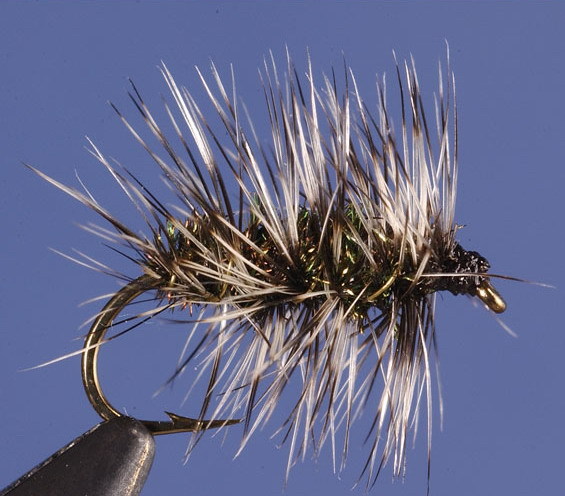
The Griffith Gnat is frequently suggested as a midge pattern for the emergence of midges (chironomids, buzzers, gnats) and I would imagine, as a beginner, few of you take it seriously. It seems to be the obligatory pattern to mention, but you seldom hear of anyone actually using it or showing the big one caught on the size 18 Griffith Gnat. It is a pain (for me) to tie in a size 18 without premium hackle. I tie it on a size 16, but tie it smallish. I also, tie 18’s but struggle to not overdress and to use those small premium hackles.
My opinion of his fly is that is it not used enough by the beginner. I have had numerous fish take the fly, but have had two memorable fish to the GG. One at Hosmer Lake (Oregon) at the boat ramp, kicking at last light (a gorgeous Atlantic Salmon) and another, at East Lake (Oregon) at the time of night when the light is fading and the midges are coming off (a slab of a rainbow). Both of these fish took the size 18 GG and I fought both quite awhile and I horsed both after repeated dives into pads and weeds. I lost both and both fish left me stunned at their size. I became a believer and have since decided to experiment with a slightly bigger hook, while striving to tie a compact body.
The pattern is simple enough: a size 16-18 fine wire hook; peacock herl, grizzly hackle suitable for a size 18 dry fly and 8/0 or 14/0 thread. The peacock and hackle stem are tied in at the rear and the peacock body is wrapped forward forming a full body and tied off. Then the hackle is palmered forward in wraps similar to a Woolly Bugger’s body formation. The hackle is clipped and the thread head is formed. Use a floating line and keep the faith as you fish it in the film and amid the hatch. Don’t horse the fish.
 SwittersB & Exploring
May I use your photo of a Griffith’s Gnat if I provide a “courtesy of… and a link to your site. I am working on an article for Montana fly patterns from early in the season to late.
LikeLike
Hello David,
Thank you for commenting. Yes, please feel free to reference anything you wish. Thank you for visiting and highlighting the site.
SB
LikeLike
Hello David: I know its been a yeear or more since this post, but can you tell the bast way to present this fly:?
LikeLike
Hello…the pattern is always in the film, little movement, doesn’t have to be greased or floatant added. I have primarily used it on lakes. It is quite serviceable on streams as well. A surface pattern for sure, but if it sunk it might be interesting too. You will often read the pattern is some clump of mating midges (chironomids). Whatever it is suppose to represent, it does well when midges, caddis or mayflies are busy just below or at the surface. Good luck.
Gary (not sure who David is 🙂 )
LikeLike