

The pattern is a heavily weighted and meant for lobbing and dredging on a short, controlled drift..ala Czech Nymphing. The fly possesses all the weight required to sink to the bottom of any deep drift. I did not weight the hook, but instead bought hooks with molded lead (they come with titanium also, I believe). Such hooks are available in Europe and the U.S. You could try wrapping lead and concocting your own. I found the hooks at one of those yearly outdoor shows via Fly Tying Specialties.
I tied a few patterns with the weighted hooks. Of note are the bodies made of wrapped latex rubber strips and the dubbed thorax with dark deer hair. Jeff Morgan, an excellent tier, first showed me the dubbed deer hair thorax. I seldom see it used. The pieces of cut deer hair can be twisted onto the thread (not easy) or placed between the dubbing loop and spun (easier). Don’t over do the amount of deer hair. A dark permanent marker was used to touch up the thorax area to give a two tone appearance.
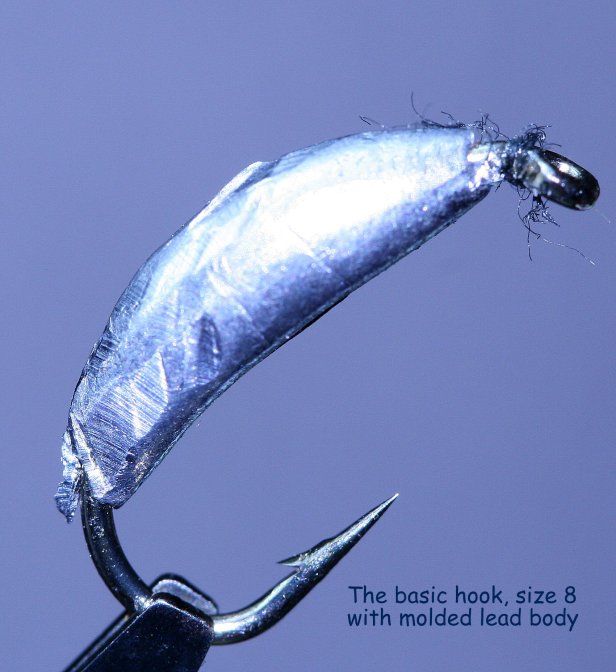
The above hook was covered with a fly pattern but I cut it away to expose the weighted underbody. I knicked the rear a bit with the scissors. Below are a few of the flies I tied using this style of weighted hook.
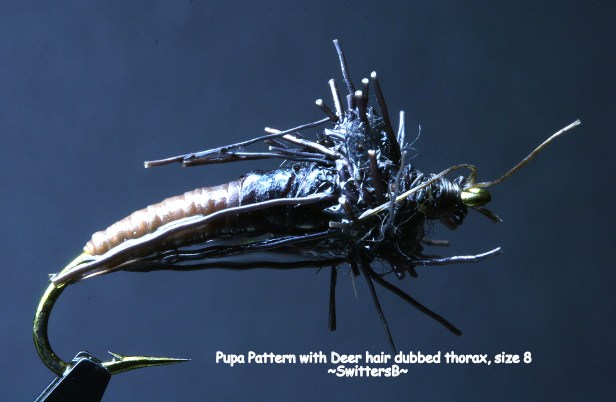

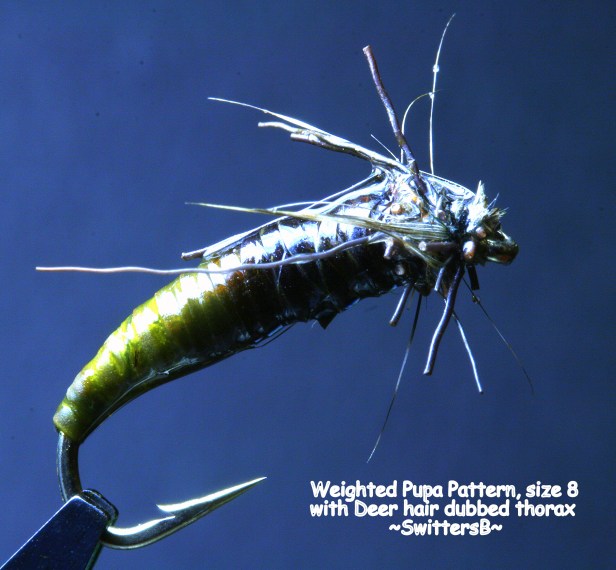
My lighting was off for these pics. So not as crisp as I would have liked….but you get the idea and I think see the value of the deer hair thorax.


This particular pattern is designed for a stream-river not a stillwater. The current propels the fly or it is guided with the rod tip through a drift with a tight line. In a stillwater situation the fly should most often be taken to the desired depth by the appropriate line….Intermediate/Type 1 to Type VI are meant to take your fly down to a desired depth at a certain rate…like a Type III usually means a sink rate of 3″ per second…a Type V at 5″ a second…more or less. All these lines should move the fly in a horizontal direction and eventually upward toward the rod tip. Exceptions to this are fishing a chironomid pattern vertically; retrieving an emerging mayfly or caddis pattern vertically or diagonally or casting a diving caddis or water boatman pattern that hits the water and sinks as if diving to lay eggs. Some of those sinking lines can be used on a river too, but more rare re trout fishing. Heavy grain lines (100-500 grain lines) are use for steelhead and salmon. Those lines allow a more horizontal presentation across the face of the fish to provoke a strike. Salt water fly fishing can utilize heavy sink lines too.
LikeLike
I respect trout. Weighted flies seem a bit selfish to me, in that especially big trout deserve the deep sanctuary where they can hide, rest or feed undisturbed. To think that the trout just dredged would have risen in an hour or so just gets to me.
LikeLike
Well, just remember this …although you may enjoy the dry fly take….fish feed 95+% of time below the surface and mostly down below because that is where the food is…and, they don’t have to work as hard. So, don’t feel too sorry for them.
LikeLike
Good Morning Scotty,
Thanks for dropping by. I must remember to send that check to Creek for the referrals…. Have a great day.
Gary
LikeLike
Nice fly pattern and great pics Switters Man!
LikeLike