

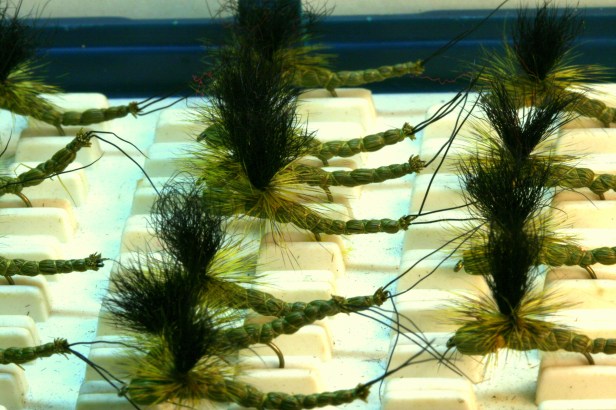
Several years ago when I was more motivated to tie more exacting patterns, I spent considerable time on fly patterns. Several things happened from this exacting behavior: I realized such patterns, for me, did not outperform simpler patterns; I hated to lose the complicated patterns; I derived no sense of satisfaction from the effort. Below are some Bunse like Green Drake duns with a deer hair bullet head, parachute, extended tail. They look damn good, but try as I may, I do as well with a Humpy or a Wulff Green Drake. Now, I am not discounting the artistic, more exacting bent of many tiers. As I have said before, my pragmatic, lazy side supersedes my artistic side. The Bunse style is novel and still worth an effort by the talented tier. (see comments section for tying info)

Now, I tied a dozen or so of these flies. And, the moose mane tail has little durability; neither does elk hair. Most have broken or bent as much from storage or casting than catching and releasing a fish. Below, you can see the damage to the tails. Perhaps today’s tail fibetts would be a far better choice?
So, below is my type of fly…a Wulff style…quicker, durable, productive. The hardest part, and it isn’t hard is the hair wing (calf tail) tied in and split to form a V wing. This a great fly for heavier waters. The ribbing could have been a little better.
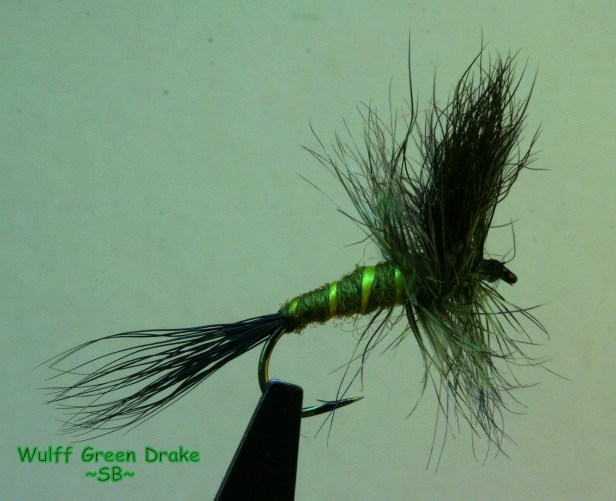
 SwittersB & Exploring
Well, drake hatches (green/brown/gray) are opportunistic events. First, when you go to a stream research the types of potential hatches. Then arm yourself with the appropriate patterns. Know what a certain hatch looks like when you are looking at it. Then the old match the hatch is not a gimme. It requires the right patttern ‘near enough’ and then presentation is critical. All part of the puzzle…fly fishing is often a thinking, reading, assessing game Ever so slightly more challenging than power bait off the bottom or a chunk of worm under the old red and white bobber. The what if part is enjoyable to most fly fishers/tiers.
LikeLike
Switters you cannot just show that creation and not provide some explanation on how to tie that! I want to tie that for the big drakes. And, what is the B for? Just giving you a bad time, but am curious on any advice you can offer. Being old..do you remember how you tied it?
LikeLike
Well, to the point Brian: B is for Bumpatter….it is a genetic code thing. As for the pattern, somewhere in the dark recesses of my mind, I recall how to tie these. I would personally never expend the effort unless I had caught a bazillion fish on them. Not saying they wouldn’t, they just haven’t done it for me. I always have them near but I do better with a Wulff or Humpy. Now for quieter waters, to the sides, this pattern does ride nice.
The bullet head: stack the deer or elk hair to even the tips. Trim the butts even. Tie in the butts at the eye with the tips of the bunch extending out over the eye, not to the rear. Cinch them down and pay attention that the thread wraps are up near the eye.
Next tie in the post of black or white calf tail or bunched Zelon/Antron/Parachute post material. After this you tie in a single high quality dry fly hackle (Dyed Green Grizzly) and wrap it around the base of the post two times and tie off. I then add a drop of zap-a-gap to the post/hackle contact points around the base and also to the thread wraps around the deer hair. I tied in the deer hair with 3/0 thread. The parachute is tied in with 8/0 thread.
Once the glue is dried, tie back on the 3/0 thread right in front of the parachute wing. Now gently work the deer hair evenly to the rear being careful to work the bundle around the sides and bottom of the parachute post. Those pieces of deer hair that would over the top on a normal bullet head are maneuvered just to the sides and under the parachute wing. When I have gathered the hair to the rear behind the parachute post I start with thread wraps to bundle the hair, trying to give an even appearance. Once you have the hair pulled rearward toward the bend don’t let go and wrap back…do not wrap all the way to the bend.
Hard part: take the tail fibers (don’t use moose or deer hair…use something durable) and put a dollop of Zap-a-Gap at the bend of the hook up the shank. The deer hair will be slightly splayed. Insert the tail fibers into the glue and let dry. Oops..forgot to tell you to gather the tips of deer hair first and cut them to a blunt end, not maintaining the fragile tips. Then put in the tail fibers.
Now insert a slender needle, but long enough to extend out past the body material and tail. Regather the deer hair and tail fibers and commence wrapping the thread out over the bundled deer hair to the end. The inserted needle gives you leverage to apply torque on the thread wraps. Then wrap back up the body toward the parachute post and around and back down and finish off. Add a gentle coating of glue to the thread wraps and at the end of the tail.
Do you see why I would rather tie the Wulff, despite how worthy the Bunse Drake looks? Too much for me. Give yourself several efforts to get it right. The glue does help with the abdomen’s durability…just don’t go for a fragile tail material.
If you try this send me pics of your efforts please.
Best Wishes…
SB
LikeLike
Thought I might leave a note in defense of the real Bunse green drake. the only similarity my foam drake has with these deer and elk hair patterns is the extended body.I developed my foam pattern because I felt that Elk patterns were so ineffective, they don’t cast, float or fish worth a damn and the are difficult to tie. My foam dun fishes, floats, and feels like a natural. it is a bit difficult to tie,especially for seasoned tyers because the process is so different from the habits they have developed but most who have tried it think it was worth the effort.. Here is an address for a website that shows step by step tying instructions. http://www.flyanglersonline.com/flytying/fotw/011000fotw.php If you send me an address I would be glad to send you a sample fly and some foam.—-Richard Bunse
LikeLike
Thank you Richard…very kind.
LikeLike