


~Know your location relative to other boats, tubes, rafts, kayaks. Yesterday, as one kayaker after another glided over my fly line some 40′ out, I asked how in the hell were they so oblivious. At the same time, I had one float tuber collide with the rear of my anchored pontoon boat. He wasn’t paying attention. No harm. No apology offered. Oblivious.
~As my left pontoon became noticeably less inflated, I noticed a I had a bit of a kick or row toward a shoreline with footing. The colder water had sapped some of the inflation. But also, I most probably had not equally inflated the pontoons. While listing to the left I attempted to row. The left oar could not come fully out of the water so at times I was taking a less than straight course toward the shore.
~Always barb your hook. Not just for the catch & release of your fish, but for the release of your hat, back of your shirt, fabric of your older pontoons, your rubber booties and the kayaker’s life jacket that skimmed along behind you and into your back cast.
~Back casts into a side wind will push the fly in the direction of the wind on the forward stroke. Figure out if that might be detrimental to you….you did barb the hook, right?
~At times it is fine to just kick or row about, trolling a fly while you explore a lake or move from point A to point B. But, you learn little about presentations of the fly if you only ever kick and troll. Anchoring up or holding steady in the winds will allow you to manipulate the fly horizontally, diagonally and vertically. Kicking along parallel to a drop/ledge from the shoal to the drop is ok, as long as you are aware of the location.
~As you fish, the rod tip should be down almost into the water with a floating line and into the water a few inches with a sinking line. Yesterday, I saw a few fly fishers with their rod held high, a big bow in the line and too much slack to consistently set the hook. Many hookups will be missed that way. The understandable exception to this is the person still using a donut shaped float tube (time to upgrade to a V tube).
~As you change flies, looking for the seducer, you can use up 2-4″ of line for each new tie on. Especially, if your fingers are frozen, you will use more line as you fumble with the knot. Keep your tippet at the optimal length. Rule of thumb: for a floating line or intermediate line keep your entire leader length at least the length of the rod…once it is reaching that stripping guide rebuild the leader. Depending upon the type of sink tip or full sink line the leader may be shorter.

~With an unsettled surface from the wind and waves, the fly line will often lay less than straight toward the fly. Often the most subtle take will be seen as the kinks, waves and bows ever so slightly straighten…set the hook. Seeing & feeling may be obscured or muted by the wind and waves.
~Birds, ducks, up at camp and your own eyes. Swarming birds over the water or slightly higher are a good indication of a hatch (midges, caddis, dragons, mayflies). Ducks working the reeds for damsels. The obvious too….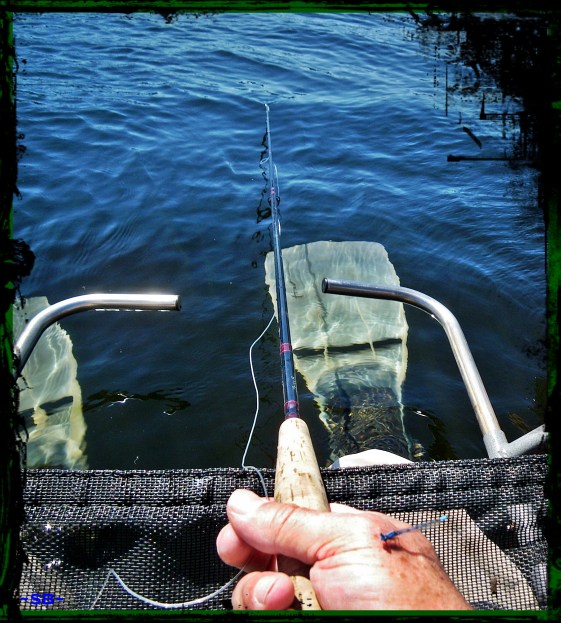
~When I went up to camp for a bite, around 2pm, the camp was a swarm with midges blown in from the lake. The family was dutifully applying DEET thinking them mosquitoes. So, I surmised there was a hatch of midges before the time I started fishing the lake at 10am. Had I been fishing the lake the next day, I would be on the water.
 SwittersB & Exploring