

V. Paul Reynolds in the Sun Journal (Maine) argues that barbless hooks are unnecessary and in fact possibly harmful to fish. Hmmm? I am astounded anyone would advocate for barbs on hooks, even treble hooks if the intent is to release the fish.
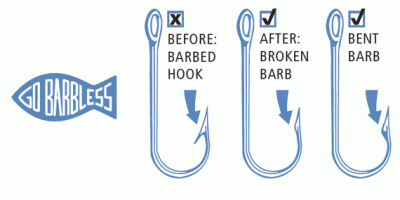
If a fisher does not know how to release a fish, whether the hook is barbed or barbless, that is a whole other educational matter to be addressed. However, the mere process of using forceps, pliers, fingers to back a barb out of fish can only be viewed as potentially more problematic for the fish…compared to a barbed hook. Over penetration? Perhaps an issue if a 8″ trout takes a size 2 streamer. But, this does not compute, biologists aside, that barbs are acceptable if releasing your catch. There just is more shaking, pulling, twisting, grabbing, stressing to remove a stubborn barb that has done its job. Barb the hooks for easier release of the fish, your ear and your clothing. Now lest I appear inconsistent, I do not smash my barbs in advance of tying, and I rarely use totally barbless hooks. I round down the barb on the water…and I do like a slight bump from the rounded down barb on salmon, steelhead hooks.
 SwittersB & Exploring
by far and away the best way to release a fish is to use the tip top of the rod as a hook remover, gently pulling the line till the tip top removes the hook (it must be barbless). The fish is often so relaxed by the whole event that it sometimes doesn’t even rush away.
LikeLike
My take: a barbless hook is much easier to remove from an angler, hence the reason I de-barb my hooks. As a note, I crimp barbed hooks prior to tying, chiefly because some of the older forged steel hooks can be brittle, and I’d much rather waste a new hook than one I’ve already tied my pattern on.
In regard to hooks and fish stress/mortality: simply hooking a fish increases it’s chance of mortality, barbed or not. Playing a fish for any duration, especially under periods of thermal or biological stresses, only increases their mortality rate. The results from the 1981 mortality study at 99% survivability rate are suspect at best, as modern C&R mortality rates are somewhat closer to 10% for salmonids. Stress and mortality rates will vary greatly by species, with salmonids having some of the highest catch and release mortality rates. Of course, if one is truly concerned about fish mortality, then they would not even angle for them at all, but that is contradictory to what we are in pursuit of.
LikeLike
Jean-Paul
You know, I have some peculiar blind spot to sitting down and de-barbing the hooks in advance of tying. I know it makes total sense. Thanks for the input, as usual.
Gary
LikeLike
Hello Boris,
There are a few key points that facilitate smoother releases, most often: rod/line handling; wet hands (always); barbed hooks always; tools and the safe, comfortable release of the fish.
Hard to explain, but don’t hoist the fish out of the water up to you and fumble about with the fish 2-3 feet over the water; tuck the rod under an arm with enough slack in the leader to control the leader in hand and draw the fish near you; if the hook is barbed it will often back out of the fish with ease; some advocate holding the hook steady with tool or finger tips and letting the fish fulcrum off the hook (I do this most often). You rarely have to hold the fish or lift it from the water but and inch or two. If you have the hook slightly deeper in the mouth then wet the hand and gently hold the fish as you back the hook out of the tongue and ease the fish back into the water. Don’t plop the fish or toss the fish. Wet hands help ease the removal of the protective slime on the fish. Infections reportedly result from dry hands drastically removing that slime/coating. Now the cold weather is near and fingerless gloves are often donned and one is hesitant to get them wet. All the more reason to have pliers, forceps to remove that barbed hook. Much of this is way easier with a little fish. Managing a much bigger fish requires a perfect harmony of calmer waters, rod/line handling, getting down near the water, calming the fish to remove the hook and taking serious time to release a tired fish. Truthfully, you have to catch a enough fish that the release technique is second nature and actually difficult to describe because you so instinctively do it.
So, don’t lift, don’t pry around to remove a barbed hook, don’t toss the fish, don’t remove the slime, don’t over play a fish fumbling around, make sure if you do over play it you take your time releasing it because the odds have gone way up it will succumb even after it swims away.
Do some research into Youtube demonstrations on correct release of fish
LikeLike