

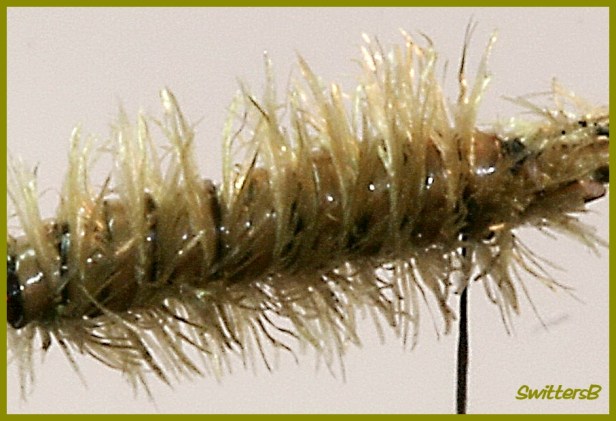
As a beginning fly tier, you need to watch for some frequent mishaps that will detract from your patterns. You want to recognize them so they don’t become a habit. Even ‘impressionistic’ tiers, like my self, need to correct these for correct proportions, realism and durability. I have included some images of flies I have tied. Often, I will tie a half dozen to two dozen of a pattern. And, as I have said, the first few will not meet up to what the pattern needs to look like. And, they show, via the macro lens, what I am doing wrong. I like to share my mistakes or slips so you can have a visual guideline to avoid.

Above, you see (left to right): left fly- the head on the fly is too large because of too heavy of thread (6/0) and the beard is too long. The center fly is a proportion issue with the bead much too large. The right fly demonstrates the eye of the hook being over crowded and the lack of thread wraps will likely cause the wingcase over the top of the thorax to come untied. Use the smallest thread you can; proportion the size of components; don’t crowd the eye.
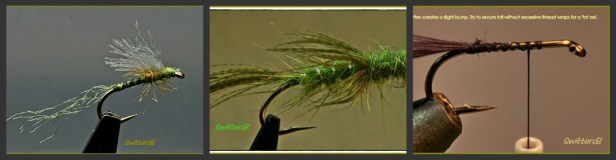
In this second sequence left to right: the tail is advanced slightly too far forward. The tail material will likely get wrapped around the bend of the hook and the fly will not present correctly. Also, the tail is slightly too long and the tail is canted away to the far side of the shank. In the middle the tail is again slightly too far forward and again pushed to the far side of the shank by thread torque. The forefinger/thumb pinch must not creep up the shank. Also, the pinch must stop the thread pulling the material to the far side of the shank as the thread is pulled over the top and down. Lastly, materials must be tied in along the shank and as lean as possible to avoid all the materials tied in at one point over the barb. This results in the ‘fat ass’ problem and prohibits the gradual taper toward the front.
Right size thread, small rear end, don’t crowd the eye, proportionment of materials, tail over the barb. These are common mistakes that hinder the start of the fly or the finish.
 SwittersB & Exploring
Hello Switters. I have been tying for many years. I still make many or most of these mistakes. For me it is enjoyable to tie and I try to improve each tie as I go along. By the time I hit the third or fourth fly I am in the groove. I still use the first few flies too. Thanks for the site. Nice effort.
Bryan @ Merritt, BC
LikeLike
Hello Jon,
With only a few exceptions (salmon/steelhead patterns for the most part) the tie in point for many trout/grayling patterns is directly over the barb of the hook. This maintains the classic pattern proportions of most trout patterns/recipes. Finger creep often pushes the tail material forward as you pinch down. Don’t set the hook too low in the vise and have your initial thread wrapped back over this hook barb point, then tie in. Enter pinch technique in my search box to get visuals on how to use the pinch technique. Thread wraps have to be tight without breaking the thread or too many thread wraps or using to thick of thread. Maintain thread tension as you wrap with no loose wraps. Hope this helps. SB
LikeLike