

The Canadian/Bristish Mining companies partnered in the enterprise stand to make billions on extracting critical reserves of ore while doing so adjacent to critical reserves of fish and their habitat. All the BS Exxon Valdez scare tactics aside, the track record for the involved companies, after all the polished permit studies and fluff are removed, is not good. Is the ore of world wide importance, and is there really a likelihood (not maybe or threatened) there will be harm to the environment? 100’s of Billions of $$$ of Gold/Copper etc. v. fish, habitat, jobs and identity. Risks, always risks. We are so risk avoidant. But, maybe here we should be?
This is the true nature of the environmental stewardship. Not snail darters, climate change (come on, not really), not veganism. This, the balance of industry v. nature. Stewardship v. cancer. Fake studies, fake concern by government, economic possibilites for the poor, broken promises, altered habitat and stories of ‘I remember when’. Those stories of ‘I remember when’ are because of a lack of stewardship.
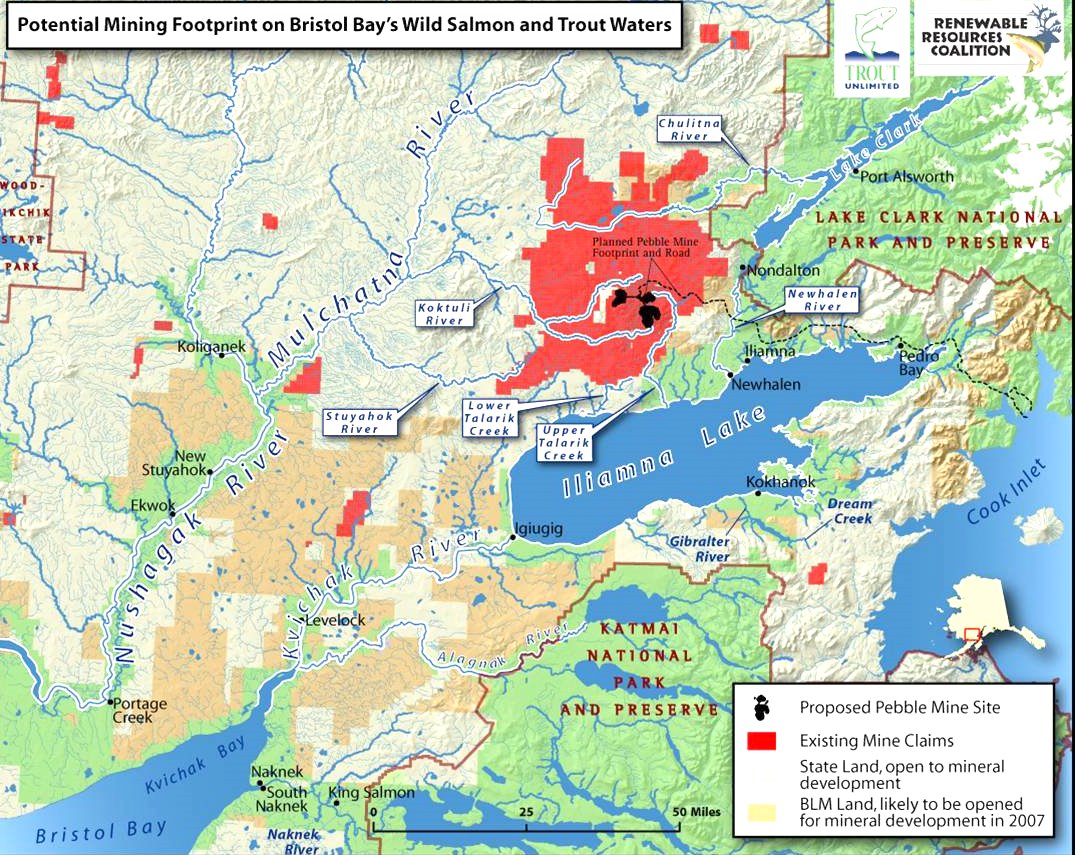
Study this issue. My gut tells me to drill and drill a lot re oil. But, my gut also tells me, having seen the big operation in BC on the way into Calling Lake and Island Lake, that there is more to learn here.
Controversy: The controversy over the Pebble Mine centers largely on its potential impact on fish and fisheries. In general, mining opponents claim that the mine poses a significant and unacceptable risk to downstream fish stocks, while mining proponents claim that the mine can be developed without significantly harming the fish.Reserves and resources: Latest estimates (2/2008 indicate that Pebble West contains (at a copper-equivalent cut-off of 0.30%): Measured and Indicated resources of; 18.8 billion pounds of copper, 31.3 million ounces of gold, and 265 million pounds of molybdenum, contained within 3026 million tons of ore and Inferred resources of 5.9 billion pounds of copper, 9.1 million ounces of gold, and 993 million pounds of molybdenum, contained within 1130 million tons of ore. There are 100’s of billions of dollars involved here when you look at mining yield and the economic impact as well as the fisheries, tourism, commercial operations and the indentity of the state….
Pebble East is estimated to contain (at a copper-equivalent cut-off of 0.6%): Inferred resources of 49 billion pounds of copper, 45 million ounces of gold, and 2.8 billion pounds of molybdenum, contained within 3860 million tonnes of ore.
By dollar value, slightly more than half of the value of Pebble is from copper, with the remainder split roughly equally between gold and molybdenum.
Pebble is now estimated to be the second-largest ore deposit of its type in the world, slightly smaller than Indonesia’s Grasberg Mine.
http://en.wikipedia.org/wiki/Pebble_Mine (General Information about the issue).
http://www.truthaboutpebble.org/ (Pro Pebble Mine)
http://www.stoppebblemine.com/links/default.asp (Cons Pebble Mine)
http://ithink.mining.com/2008/08/01/pack-your-gun-anglo-american-pebble-mine-versus-human-nature/ (Cons Pebble Mine)
http://www.pebbleminealaska.com/ (Cons Pebble Mine)
http://www.aktrekking.com/pebble/LakeIliamna/LakeIliamnaPhotos.html (Interactive Map of Area)
I have a very hard time trusting environmentist activists, because they hate business and capitalism. I have a hard time trusting big business for the same reason I do not trust big government, they are too insulated and in a hurry to seriously care about the environment beyond required permit studies. Exceptions? Yes. I fear both sides exaggerate, lie and over state and we never understand the truth. A balance seems impossible with such rhetoric. Of course, it would be in Anglo American’s best interest to spend the millions to safeguard the resources at all costs and maybe restore their global reputation.
https://swittersb.wordpress.com/2008/08/16/warmist-alarmist-saturation-group-think-propaganda/
 SwittersB & Exploring
“When the mine is finished in 20 years they jobs and the money will be gone” This is not a 20-year mine, it is a 60+ -year mine. Once the infrastructure is in, satellite deposits will be economic. There will be new developments. Mines need miners, maintenance, road repairs, new equipment – the list goes on. The jobs will be there forever.
And not that they can’t co-exist, but salmon fishing is a $100 million/yr industry. Pebble/Pebble East has approximately $500++ Billion in resources at today’s prices. That’s 5000 years of fishing. So the money will keep on coming. Unfortunately, we have an uninformed public (like Dupree), unaware how desperately the US needs copper and who think there are better alternatives (like savethefish21) somewhere else, of course. Although perhaps they anticipate electricity will be conducted by algae.
LikeLike
If interested in revisiting this topic, you’d probably appreciate checking out pebblewatch.com, a site that offers good solid information. It’s run by Bristol Bay Native Corporation, and offers info on everything from science, to permitting timelines to the current EPA actions. Good stuff — different from the advocacy sites you will see. (Check out the FAQ page for an intro.) Full disclosure — I was involved in putting it together, and have been genuinely impressed w/BBNC’s commitment to maintaining this as an unbiased resource. Take a look and let us know what you think!
LikeLike
Thank you Sonya. It does appear to have a balanced appearance…something seemingly rare these days. Thanks and it is a very nice site…well done.
LikeLike
When the mine is finished in 20 years they jobs and the money will be gone. If left alone the fish will continue for ever. Maybe the mine will not impact the fish, but would you not rather err on the side of caution. The miners say that they can mine with no impact. Thats the same assurance the oil people told us about the pipeline. And why does everything always come down to money, is it sometimes enough to preserve some things simple for their beuty and wildness?
LikeLike
Louis..
What has been the impact of the pipeline on habitat, environment, etc?
LikeLike
Why should we mine here. I’m not a person that is saying we should go in a cave like other people think, but we don’t need to mine here. Pretty soon, electricity won’t even be generated by fossil fuels anyway, and the wildlife neds to be preserved
LikeLike
Although we are all responsible for protecting the environment, I think we should also look at the real potential for development that the area in question faces. Fish and fishieries are important, but when you look at billions of dollars that would be fueled into the local economy, wouldn’t you wonder if we can come up with creative solutions that allow both the fish and the oil companies to co-exist peacefully?
Now that environmental awarenes is heightened, I’d imagine big companies are clear on the importance to separate budget money for environmental needs and resources. My suggestion would be to call them on it and make sure there are environmental management plans that ensure the best possible scenario for local wildlife and fauna, but beyond that… let’em come!
LikeLike
All you can trust right now is the common sense of the people of Alaska. The land is theirs, and the decision to proceed is theirs. They collectively will reap the benefits and downside to any decision they make. We bloggers can note, analyze, offer opinions, but in the end democracy, imperfect as ever, will prevail in this instance. And all we can be glad of it that this ore body is in a jurisdiction where democracy and popular common sense have a chance to be effective. So we will watch the people of Alaska exercise their democratic rights. (I have written more on this topic on my blog I THINK MINING.)
LikeLike
It is getting colder from now on. The greens have always got everything they touched wrong. It wont stop them though. You are rght to mistrust.
http://nzclimatescience.net/index.php?option=com_content&task=view&id=321&Itemid=30
“They will not be satisfied until they have you shivering in a cave, sipping thin gruel.”
LikeLike